
Nyungne Retreat
Nyungne (pronounced NYUNG NAY) is a special fasting practice of purification and renewal practiced by all the major traditions of Tibetan Buddhism. Each year at the Institute, usually during Saka Dawa, the profound group retreat practice of Nyungne is undertaken – a practice of the eleven-faced thousand-armed form of Chenrezig.
It is extraordinary both for its profound spiritual power in the purification of karmic obstacles and wrongdoing, accomplishment of enlightened the qualities and for its practicality in application.
Participants are required to undertake vows of certain precepts and follow ritual guidelines of meditating, and speaking at appropriate times prostrating, chanting, eating, drinking as part of the purification pocess. Through devotion and determination, practicing Nyungne allows for the positive cultivation of the mind and the accumulation of immeasurable merit.
fasting of body (food and drink) purifies obscurations of the body
fasting of speech (silence) purifies the obscurations of speech
fasting of mind (meditation) purifies obscurations of the mind


Through devotion and determination, practicing Nyungne allows for the positive cultivation of the mind and the accumulation of immeasurable merit:
Nyungne is a practice of the eleven-faced, thousand-armed form of Chenrezig (Avalokiteshvara). Chenrezig is the embodiment of all the love and compassion of all Buddhas of past, present, and future in the form of a bodhisattva. By his very nature therefore, he is a great bodhisattva who benefits all beings continually, and is regarded as the source of all blessings.
We have all accumulated a great deal of obscurations in our countless lifetimes in cyclic existence. However, by meditating on the form of Chenrezig, repeating the mantra of Chenrezig, and resting in meditation on Chenrezig, we can purify all these obscurations and all of our wrongdoings of body, speech and mind.
Through this practice we can accomplish what are called the two attainments, or siddhis. The first of these, common attainment, means achieving such benefits as a fortunate rebirth, longevity, wellbeing, and so forth. The second is called supreme attainment. This is the ultimate fruition which is Buddhahood.
This practice of Chenrezig involves meditating on love and compassion for all beings. By meditating on this deity, it is possible to develop extraordinary love and compassion. In doing so, you will gradually become more and more like him and develop the genuine ability to benefit others.
The practice of meditating on the Bodhisattva Chenrezig is a way to purify and remove ignorance and negative mental patterns and thereby reveal our own innate buddha nature, which is the essence of love, compassion, and bodhicitta.
Nyungne effectively integrates the complete three-yana system of Tibetan Buddhism into a two day retreat format. Practitioners take on temporary ordination by observing a strict set of vows from the tradition of individual liberation (Hinayana). They generate the supreme altruistic motivation of bodhicitta as the internal basis for practice (Mahayana). They also perform the liturgy, mantras, visualisations, and ritual observances of One Thousand Arm Chenrezig from the kriya tantric tradition (Vajrayana).
The special and unique quality of the Nyungne practice is that it is greatly beneficial for people who are very busy, particularly householders who can only spare a day or two at a time for intensive practice. Because the practice is so powerful, they can accomplish a tremendous amount even in one or two days. It is an especially significant practice for those who are practitioners of the Karma Kagyu tradition because our guru, the Gyalwang Karmapa, is the continuous incarnation among us of the bodhisattva Chenrezig.
The benefits of practicing Nyungne:
Every prostration that we complete accumulates immeasurable merit, therefore when we prostrate, we give heartfelt dedications of our merits to all sentient beings.
Silence allows one to remove all distractions and to only focus on one’s practice. It is a profound opportunity to enter a more ‘contemplative’ space deep within our heart. This sacred space can help begin to grow within us a reconnection to both our inner awareness, pure diamond wisdom mind, thereby providing a breathing space in detachment from our small ‘I’ ego (monkey) mind that dominates so much of our day-to-day thinking and consciousness.
The practice of Nyungne involves doing what is called the renewal and purification practice of the Eight Vows, or sojong in Tibetan. It is with the taking of those vows that the practice begins. About sojong practices in general, it was said by Guru Rinpoche:
“The function of such a practice is to renew or refresh all forms of virtue and to purify or remove all manner of wrongdoing. It is called renewal and purification because it renews or refreshes virtue and purifies and removes wrongdoing. That is why the sugatas (the Buddhas) have taught this practice.”
The Eight Mahayana Precepts (for the duration of the retreat):
The benefits of moral discipline are set forth in The Sutra that Presents Pure Moral Discipline, which says: Just as someone who is unable to walk, cannot walk on a road, in the same way if you do not have moral discipline you cannot traverse the path to liberation. Someone who possesses moral discipline will receive perfect and genuine awakening.
In the sutra called The Illuminating Moon it says: There is more merit in someone keeping the training for one day and night at this time in which the teaching of the sugatas (buddhas) is about to cease, than there would be in venerating billions of buddhas for an innumerable amount of kalpas.
In addition, Vasubandhu said: to keep moral discipline for one day brings more merit than to engage in generosity for one hundred years. If you respect the Buddha’s teachings and have confidence in their truth and validity, then you will be confident that these benefits truly do accrue.
There are three mantras used in the Nyungne Practice. There is the long dharani, the short dharani (which is the second half of the long dharani used alone), and the six syllable mantra, Om Mani Peme Hung.
In the kriya tantra it says that anyone who recites the long or short dharani of the Thousand-Armed Chenrezig will enter into the awakening of all Buddhas and the liberation of all bodhisattvas. Therefore it is called the essence of wisdom. It is also said that if you recite this dharani even once in the ear of an animal who has died, it will definitely be reborn in Sukhavati or the human realm with a good human body and a tendency towards Dharma and Bodhicitta. The many wondrous aspects of all this could not be completely explained even by the vajra tongues of the buddhas. It is sufficient to say that the repetition of this dharani brings incalculable benefits.
Keep in mind, however, that all of the benefits described depend upon reciting the dharani with a one-pointed mind of devotion. You will not attain the same results if you just recite it verbally while your mind is distracted. Therefore, be mindful and alert, engaging your body, speech, and mind in the recitation, and do not be concerned with the number of mantras recited. Practice in such a way that you are constantly aware of your own mind. If you do so, then all of the benefits will indeed arise in you, you will be able to accomplish all virtue, and you will be on the genuine path.
Extract – “Extraordinary practice of Nyungne: Its History, Meaning and Benefits” in: Rest for the Fortunate by Bardor Tulku Rinpoche, Rinchen Publications, 2004, pp35-37.
Nyungne, which is one of the most popular Tibetan Buddhist fasting practices today, started with the ancient Afghani princess Lakshminkara who was born into a royal family during a time when Afghanistan was a great Buddhist nation. In Buddhist history books, this place is known as Oddiyana, in what is now northwest India. Lakshminkara decided to become a Buddhist nun and practice the dharma. Ordained as Gelongma Palmo, she was abandoned in the forest after contracting leprosy, an illness which was widely feared in India. She overcame and was completely cured of her terrible illness through devoted and extensive practice of 1000-Armed Chenrezig, the Buddha of Great Compassion. Gelongma Palmo become the first holder of the Nyungne lineage and passed the methods and blessings of this practice down through a lineage of practitioners that continues to this day.
TUESDAY 10TH, WEDNESDAY 11TH, THURSDAY 12TH JUNE 2025
We will advise when registration is OPEN closer to the time of the retreat.


From time to time, it can be very beneficial to take the opportunity for private retreat. The focus of the retreat and its activity can be from our daily practice or an extension of it.
Retreat has an intention and purpose there at the beginning. A structure is very helpful as a support. It is a source of growth for our practice. Its benefit is dedicated at the end.
If you are thinking of a personal retreat, or you would like advice about your daily practice, you are invited to email us with an appointment request, for an audience with our Resident Lama.
MAHAKALA PUJA CEREMONY
SATURDAY 14TH, SUNDAY 15TH, MONDAY 16TH FEBRUARY 2026
Traditionally we finish the year (according to the Tibetan calendar) by offering prayers to the Dharma Protector Mahakala to clear away obstacles, so we begin the new year afresh. This practice is aimed at clearing away any obstacles remaining from the old year so that the New Year will bring peace and harmony and abundance, both on a personal level and to the world in general. It is an effective way of letting go of negativity of body, speech and mind for the year ahead.
CHIMLHU HEALING AND LONG LIFE CEREMONY
MONDAY 16TH FEBRUARY 2026
This is an extremely beneficial ceremony which helps with the removal of sickness and disease.
NUDRUP LENCHOK BLESSING CEREMONY
TUESDAY 17TH FEBRUARY 2026
Nudrup Lenchok means to attain Siddhi or Accomplishment from Mahakala, the Great Protector of the Kagyu Lineage. The Nudrup Lenchok Blessing Ceremony is a very special and powerful ceremony which is only offered once a year so Venerable Lama Tsewang would like to encourage everybody to embrace this opportunity to attend such a very beneficial start to the New Year.
WEDNESDAY 18TH FEBRUARY 2026
Celebrations involve reciting long life prayers, followed by a rice and tea ceremony. Everyone will have the opportunity to offer the traditional white silk khatas (scarves) to the throne of
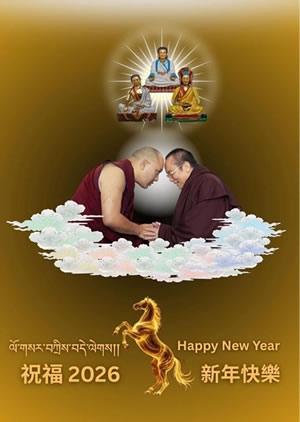
His Holiness the 17th Gyalwang Karmapa and Guru Vajradhara His Holiness Chamgon Kenting Tai Situpa. Making offerings is an opportunity to practice generosity and generates merit and positive karma.
PRAYER FLAG HANGING and SANG PUJA
FRIDAY 20TH FEBRUARY 2026
The hanging of prayer flags followed by a Sang Puja (Fire Puja) for the removal of obstacles and the increasing of prosperity. Birthday Celebrations for GURU VAJRADHARA HH CHAMGON KENTING TAI SITU SUNDAY 22ND FEBRUARY 2026
Long life prayers and celebrations marking the 73rd Birthday of HH Tai Situpa.
MONDAY 2ND MARCH 2026
In the Tibetan Tradition, Tsog is a Tantric Yoga Practice, a ritual offering expressing gratitude to teachers and the lineage. It is an opportunity to repair and renew our sacred commitments or vows. Offering Tsog is one of the most important practices for the accumulation of merit and wisdom. As tsog, the food becomes transformed through visualisation into nectar

Kagyu Lineage thangka – Artwork by Robert Beer
CHOTRUL DUCHEN
28 FEBRUARY – 14th MARCH 2025
The first month of the Tibetan New Year is known as Miracle Month. Historically the Buddha performed miracles on each of the first 15 days of this month so as to instil devotion and increase merit among followers.
SAGA DAWA DUCHEN
12-14th JUNE 2025
Falling on the fourth month of the Tibetan Calendar, the religious festivities of Saga Dawa peak on the 15th Lunar Day when there is a full moon. This day is associated with three major events in the life of the Buddha – his birth, his enlightenment on a full moon night, and his Parinirvana. It is a very powerful time to practice and increase one’s commitment to both practice and study. It represents one of the holiest and most sacred days in Tibetan Buddhism.
CHOKHOR DUCHEN
This observance marks when the Lord Buddha first taught Dharma and is often referred to as the first turning of the wheel of Dharma (Dharmachakra Day). The literal interpretation of Dharma means truth and refers to the teachings of the Buddha and the term Chakra means wheel, henceforth the term, turning the wheel of Dharma. The Tibetans use the term “the wheel of transformation” The wheel is a representation of the cycle of samsara, or rebirth. The cycle can only be broken by following the Buddha’s teachings.
The first discourse at Deer Park in Sarnath which is near Varanasi (a holy city situated on the banks of the River Ganges in the Indian state of Uttar Pradesh) is known as the “first turning of the wheel of dharma.” Here the Buddha taught Dharma to his five disciples after attaining enlightenment and taught the Four Noble Truths and the Eight Fold Noble Path. Subsequent discourses at Rajgir and Shravasti are known as the “second and third turnings of the wheel of dharma.”
LHA BAB DUCHEN
This auspicious day is celebrated to observe the descent of Buddha from the Tushita God Realm to Sankhasa in the city of Kashi. Buddha Shakyamuni is said to have travelled at the age of forty-one to Tushita (the heaven of the thirty three) for three months in order to give innumerable teachings to benefit the gods in the desire realms and to repay the kindness of his mother Mahamaya who had taken rebirth as one of the gods by liberating her from Samsara.
It is part of the Tibetan Buddhist Tradition to engage in virtuous activities and prayers at these times, as the effects of positive and negative actions are multiplied by ten million. Meritorious activities revolve around sila (morality), dana (generosity) and bhavana (meditation).
MILAREPA TSOG PUJA
THURSDAY 13 MARCH
On the anniversary of Milarepa’s Paranirvana, the Institute will be celebrating with Milarepa Guru Yoga Puja and Tsog Offering Ceremony.
In the Tibetan tradition, Tsog is a Tantric Yoga Practice, a ritual offering expressing gratitude to teachers and the lineage. It is an opportunity to repair and renew our sacred commitments or vows. Tsog is one of the most important practices for the accumulation of merit and wisdom. In tsog the food becomes transformed through visualisation into nectar

Level 3, Original Purity: meditations connected with Buddha nature, which is the basis of Vajrayana, the last of Buddha’s teachings, will allow students to discover their enlightened nature, the primordial purity of the mind and the universe, and to experience pure perception of everyone and everything.
In this level students will:
1. Discover the primordial purity of their own mind and the universe
By discovering through advanced insight their own Buddha nature and the original purity of everything.
2. Learn how to reveal that purity
By appreciating and developing gratitude for one’s own enlightened mind, by meditating on guru yoga, and by learning about creation and completion stage meditations according to the Vajrayana.
Level 2, Awakened Heart: through meditations on loving kindness, compassion, joy, equanimity, and so forth, students will learn to awaken their hearts and discover their innate goodness, further enriching the calm state of mind and deepening their meditation through recognition of emptiness, which is the essence of the Mahayana.
In this level students will:
1. Discover their inner goodness
By discovering and cultivating love, compassion, appreciation or joy, and equanimity.
By developing their potential through six perfect states of mind, the six paramitas.
By training their mind to transform defilements into love and compassion.
2. Widen their motivation and outlook and gain deeper insight
By learning about and meditating on bodhicitta, the awakening mind.
By gaining an advanced insight that understands selflessness through direct experience.
Level 1, Inner Peace: focuses on calming the mind and developing insight and wisdom through some simple yet profound study, meditations, and contemplations derived from the Shravakayana teachings of the Buddha. Awareness meditations and precise knowledge will allow students to discover inner peace, accept and let go of worldly concerns without grasping at or rejecting them, and develop a stable aspiration for genuine freedom. Guided meditations and question-and-answer sessions will help students learn how to start a daily meditation practice at home.
In this level students will:
1. Learn the essence of meditation
Develop and nurture awareness and inner peace using breath, body, feelings, thoughts, emotions, and phenomena as a support for meditation.
2. Learn the basics of Buddhism through knowledge and advanced insight meditation
Understand the shortcomings of one’s life and the world, the origins and cessation of suffering, and the means to reach that cessation, along with understanding refuge-the starting point of the path to an everlasting state of well-being, rich with innate goodness and radiant pure qualities.
Develop advanced insight meditation mainly based on experiential observation of the natural flow of everything as being impermanent.